Limestone and Lymeswold: Branding Place

From the BrandHistorian’s Timeline: 1982

The power of place in the art of branding cannot be overestimated. The Brand Historian’s favourite white wine – at least when someone else is paying – is Meursault. This mouth-watering greeny-gold burgundy with the eyewatering price is produced with Chardonnay grapes by just a handful of vineyards on the Jurassic marls and limestones of the Côte de Beaune. If my host really wants to push the boat out, I might choose one of the Premier crus, perhaps Les Perrières or Les Genevrières which are the buttery big mommas of the Burgundy slopes, where terroir really does add some value.

Provenance has long been a powerful means of differentiating and adding value to commodities. From Italy, we relish Amalfi lemons or Parma hams; from France, we seek out Crème Fraiche D’Isigny and Roquefort. And whilst the UK has been a little slower compared with the Italians and French to get into the Appellation game, protected status has been increasingly sought by British specialities like Scotch beef, Welsh lamb, Cumberland sausage and Melton Mowbray pies. In the cheese market, the world beyond cheddar has long been represented by an array of Territorials which proudly boast their geographic origins: for example, Wensleydale, Single Gloucester and Shropshire Blue. But branding based on a provenance is not without its dangers, as shown by the 1982 launch of a new cheese called Lymeswold.

The Milk Marketing Board was a UK state-run organization of dairy farmers set up to manage the milk supply chain. In the 1980s, there was a surplus of milk, so the Board set up a commercial arm called Dairy Crest, tasked with finding profitable new markets.

One of Dairy Crest’s first actions was to set up an innovation skunkworks team ominously called the SPG. One of several opportunities the SPG identified was the market for soft cheese, exemplified by French cheeses like Brie and Camembert. While the market was much smaller than classic British hard cheeses, it was upscale, aspirational, and becoming increasingly popular. The team soon identified a promising candidate product – a soft (slightly) blue cheese with an edible white rind which tasted good. Using a classic 1980s product development programme, which included the obligatory mini-van test, the product was set for a full-scale launch. The brand name selected and endorsed by the consumer was to be Wymeswold which it was thought connoted the traditional, bucolic values of rural England.

But just before the national campaign broke, it was discovered there actually was a town called Wymeswold, located in Leicestershire, hundreds of miles from Somerset where the new cheese was being produced. With a launch date looming, the decision was made to call the product Lymeswold.

Lymeswold was launched nationally in 1982 with a high-profile ad campaign (French dudes in 2CV failing to discover the delicious cheese cunningly hidden by the Brits) and PR (government minister and grateful pet dog.) Initially, the product sold well. Indeed, so well, there were supply problems.

But the first English new cheese for 200 years, as the PR described it, turned out to be a classic shooting star. A combination of significant problems in scaling-up production, product reliability issues and a trade relationship disaster resulted in the brand’s investment programme being first curtailed and eventually cancelled. Lymeswold past its sell by and was eventually removed from the market in 1992: the pleasant tasting soft cheese with a made-up name dreamt up at the last minute by the marketing men had become a bit of a joke and a Private Eye running gag.

A sad, personal postscript to this story came later when the Brand Historian visited a Dairy Crest creamery and saw a mountain of now redundant Lymeswold cheese moulds. 

The sudden rise and fall of Lymeswold shows how the power of place can help make or break a product. Lymeswold’s subsequent (and brief) re-appearance as Westminster Blue shows how in the age of political satire, we were still taking chances with brand naming.

1982 Playlist 

The Land of Make-Believe Bucks Fizz.
Food and the Power of Place

An A to Z of food and food brands

A Arbroath Smokies, Aberdeen Angus, Amalfi Lemons, Asti Spumante

B Bakewell Tart, Black Forest Gateaux, Baked Alaska, Buffalo Wings

C Cornish Pasties

D Dublin Bay Prawns, Dundee Cake

E Eccles Cakes

F Frankfurter

G Gouda

H Hildon Water

I Idaho Red

J Jersey Royals, Jaffa Cakes, Jarlsberg

K Kentucky Fried Chicken, Kendal Mint Cake, Key Lime, Chicken Kiev

L Lancashire Hot Pot

M Melton Mowbray Pie, Madras Curry

N New England Chowder, Salade Niçoise

O Oxford Blue

P Parma Ham, Pilsner, Philadelphia Cheesecake

Q Quiche Lorraine

R Roquefort

S Sisteron Lamb, Sancerre

T Turkish Delight

U Ulster Fry

V Vougeot

W Wensleydale

X Xeres

Y Yorkshire Pudding

Z Zamarano

Toujours Provenance!

 How the Shotover brewery got its name


Provenance is one of the most fertile sources of inspiration for the brand builder and one of the most powerful tools in the armoury of positioning. Consider Parma ham and Amalfi lemons; Champagne and Roquefort; and even closer to home, Melton Mowbray pork pies and Aberdeen Angus beef. In today’s hypercompetitive world, protected geographical status provides an important barrier to entry and it’s interesting to note that Italy (267) and France (217) currently well outnumber the UK’s 65 registrations.

Even closer to home, anyone walking down Broad Street or The High will see and experience what a very valuable brand *Oxford* has become thanks not just to the University and its colleges, but also to Alice, Morse and Harry Potter, amongst others. But whilst Oxford is justly world famous for its University, it was also known until recently for being something of a real ale ‘desert’, especially after Morrell’s ceased brewing in 1993.

But one beer enthusiast’s problem is another’s opportunity. In this case, the enthusiast was Ed Murray, and the opportunity was to bring craft beer to Oxford. Ed is one of the few people I know who can be truly said to be a Renaissance Man and an artful strategist. In a long career, Ed has been a teacher, electrician, aid worker and business consultant and when I first met him, also a home brewer of some repute whose Horspath home-shed brews carried a friendly Black Cat label.

Following his passion, and frankly against the advice of a number of experts, including me, Ed was determined to ride the wave of the microbrewing revolution and in 2008 with some funding from the EC, started realising a bigger brewing venture. Extending the shed was never going to be a serious option, and Ed and Pip, his wife and business partner, started a search in the locality for suitable premises. They soon spotted a 200-year-old stable-block  in Horspath in the appropriately named Cooper’s Yard, and immediately began the necessary renovations to install a brand new 8 bulk barrelbrewery.

The new brewery was situated on the eastern border of Shotover Country Park which over the years our two families had much enjoyed, especially the circular walk from and to Horspath via the Avenue and Wheatley. A long walk on Shotover is the perfect dose of mindfulness for any stressed out executive.

With the countdown proceeding fast to commissioning the kettles and brewing the first production samples, the marketing plan had to be finalised. As acting Chief Marketing Officer, I was invited with Babs, my wife, to a Sunday lunch with the Murrays where the brand plan would be brainstormed over a huge pork roast.

Whilst I’ve launched many products in my marketing career, I have to confess not all of them have been something to be proud of: the yoghurt cream liquor is a case in point. But working with Ed on his new brewery was a genuine labour of love and allowed me to atone for some of the shockers which bore my finger prints.

Ed and Pip were fiercely committed to the idea of local products for local people, and so it was inevitable that we would draw on the local landscape to tell our brand story. We were not interested in cut-and-pasting the standard Oxford clichés. Our challenge was to find the right balance between respecting traditional ale and beer codes and expressing them in a contemporary way.

Shotover provided a wonderful and timeless world for us to explore for our brand story: the Kimmeridge Formation geology; the ancient forest; the myths and legends like Empress Maud’s fossilised tears or John Copcroft’s throwing a volume of Aristotle against a charging wild boar; the beautiful Bluebells battalions on the move in May…. Shotover had it all.

Thus, it was in the course of one epic Sunday afternoon lunch that The Shotover Brewing Company was born, and its story sketched out on an A3 layout paper splattered with gravy.

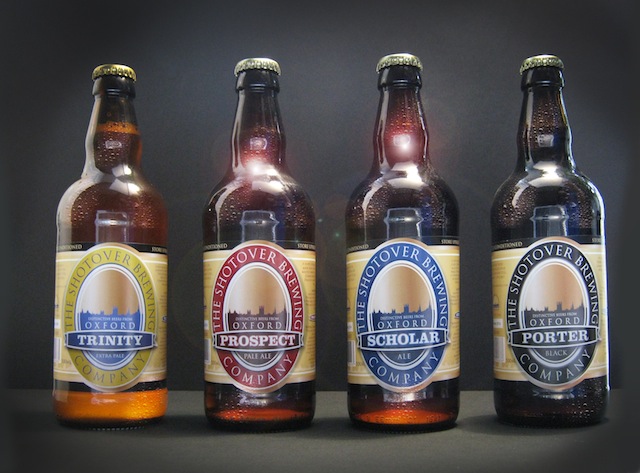
Soon afterwards, Ed’s first two beers Scholar (with the blue label) and Prospect (red) were available sporting the distinctive identity of the dreaming spires created by Guy, our designer. These have since been joined by Trinity (yellow) and Porter (black).


Shotover bottles 2

Today Shotover beers are available throughout Oxford and the county and can be found in over 30 pubs. Shotover ales have now become another great reason to visit Oxford, not to mention its ancient country park, once more underlining the power and value of place and provenance.


Paul Christopher Walton

Chief Marketing Officer (Hon)


A version of this article appears in the Summer 2018 edition of The Shotover Preservation Society newsletter.